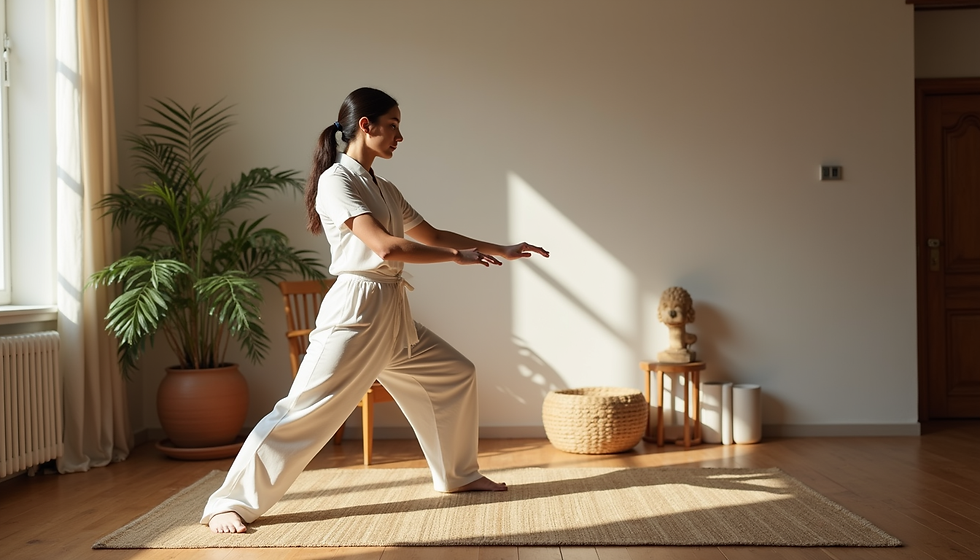
Traditional Yang Family Ten Essentials

Tai Chi is often described as a moving meditation, and beneath its graceful appearance lies a deeply refined internal art rooted in balance, awareness, structure, and intention.
For generations, practitioners of Traditional Yang Family Tai Chi have studied a set of foundational principles that guide both movement and internal development. These teachings are not simply technical instructions; they are reminders of how to move with greater harmony, efficiency, and connection between body and mind.
Whether you are new to Tai Chi or have practiced for years, these principles offer timeless guidance that can transform the quality of your practice.
Here are the 10 Essentials from Master Yang Chengfu (1883-1936).
Below, is a simple explanation of what each one of them means.

1. Empty, Lively, Pushing Up and Energetic
The head should feel naturally lifted, as though gently suspended from above. Avoid stiffness or tension in the neck. When the posture is relaxed yet alert, energy and circulation can move freely through the body, creating a feeling of calm awareness and vitality.
2. Hold in the Chest and Slightly Round the Back
Rather than puffing the chest outward, allow it to soften slightly inward. This helps the breath and energy settle naturally into the lower abdomen (referred to as the lower dantian in Tai Chi terminology). As the chest relaxes, the back gently expands and lengthens, creating a connected and powerful structure.
3. Relax the Waist
In Tai Chi, the waist acts as the center of coordination for the entire body. A relaxed waist allows movements to flow smoothly and helps transfer power efficiently between upper and lower body. Stability, balance, and fluid turning all originate from this central connection.
4. Distinguish Between Empty and Full
Weight should always transfer clearly from one leg to the other. One side supports while the other remains light and mobile. Understanding this distinction creates smoother stepping, better balance, and greater agility in movement.
5. Drop the Shoulders and Elbows
Tension in the shoulders interrupts the natural flow of movement. Allow the shoulders to soften downward and the elbows to remain heavy and relaxed. This creates a more grounded structure and prevents unnecessary muscular strain.
6. Use Intention Rather Than Physical Force
Tai Chi emphasizes awareness and coordination over brute strength. Instead of forcing movements, practitioners guide the body through focused intention and relaxed structure. Over time, this develops a type of internal strength that feels connected, efficient, and deeply rooted.
7. Coordinate the Entire Body
True Tai Chi movement involves the whole body moving together as one unit. The feet, legs, waist, hands, and eyes should remain connected and synchronized so that no part acts independently from the rest.
8. Unite the Inner and Outer
External movement should reflect internal intention. The body, breath, focus, and spirit all work together harmoniously. When inner awareness and outer form align, movement becomes natural, fluid, and complete.
9. Move Continuously Without Interruption
Tai Chi movement should resemble the steady flow of water; smooth, connected, and uninterrupted. Transitions are continuous, without abrupt stops or broken energy. This develops both physical coordination and mental calmness.
10. Find Stillness Within Movement
Although Tai Chi involves motion, it also cultivates inner quietness. Practicing slowly and mindfully encourages deep breathing, relaxation, and mental clarity. The goal is not simply movement, but the ability to remain calm and centered while moving.

These principles are not mastered overnight. They reveal deeper meaning through consistent practice, patience, and mindful repetition. Over time, what first appears to be simple movement becomes a profound study of balance, relaxation, awareness, and internal connection.
Tai Chi is more than exercise; it is a lifelong practice of harmony between body, breath, and mind.