Tai Chi History

A Living Chinese Tradition
What began centuries ago as a martial art practiced within small Chinese communities has grown into one of the world’s most respected mind-body exercises.
Today, Tai Chi is practiced across the globe in parks, wellness centers, martial arts schools, hospitals, and community programs by people of all ages.
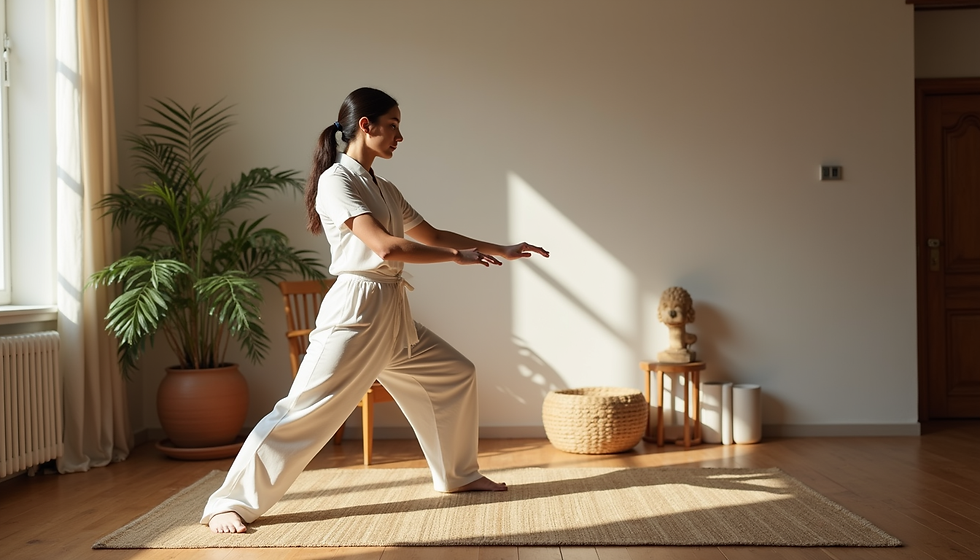
Often described as “meditation in motion,” Tai Chi combines slow, flowing movements with posture awareness, breathing, balance, and focused attention. While its roots are martial, many people now practice Tai Chi primarily for health, relaxation, and personal development.
The movements are performed in a continuous sequence, creating a smooth and graceful flow from one posture to the next.
Unlike high-impact exercise, Tai Chi emphasizes softness, coordination, and relaxation rather than force or speed.
Modern research has shown that regular Tai Chi practice may help improve balance, mobility, coordination, stress management, posture, and overall well-being.
Because the movements are gentle and adaptable, Tai Chi can often be practiced well into later stages of life.
Beyond physical exercise, Tai Chi is deeply connected to traditional Chinese philosophy, especially the principles of harmony, balance, and self-cultivation.

The Origins of Tai Chi
The early history of Tai Chi is a blend of documented history and Chinese legend dating from either 960, 1247 or 1279.
One of the most famous stories attributes the creation of internal martial arts to the Taoist monk Zhang Sanfeng. According to legend, he observed a confrontation between a crane and a snake on Wudang Mountains. Rather than meeting force with force, the snake responded with calmness, precision, and flexibility. This idea of yielding rather than resisting became a foundational principle in internal martial arts traditions.
While historians cannot fully verify these stories, they remain an important part of Tai Chi culture and philosophy.
The earliest historically documented roots of Tai Chi trace back to Chenjiagou, a village in Henan Province where the Chen family preserved and developed what is now known as Chen Style Tai Chi. For generations, the art was taught privately within the family and refined through disciplined practice.
Yang Family Tai Chi
In the 19th century, Yang Luchan traveled to Chen Village to study the art deeply. After years of dedicated training, his skill became widely respected, earning him the nickname “Yang the Invincible.”
Yang Luchan later taught martial arts in Beijing, including within the Imperial Court. Over time, he and later generations of the Yang family adapted the training method by slowing the movements and creating a smoother, more even pace.
This made the practice more accessible to a wider range of people while preserving its martial principles and internal depth.
From that point forward, Yang Style Tai Chi spread rapidly throughout China and eventually across the world.
Today, it is the most widely practiced style of Tai Chi, recognized for its large open movements, steady rhythm, and emphasis on relaxation and balance.
The Main Styles of Tai Chi
Traditional Tai Chi developed into several major family styles over time:
Chen Style — Known for its spiraling movements, explosive power, and martial intensity.
Yang Style — The most widely practiced style, featuring open postures and smooth, flowing motions.
Wu/Hao Style — A smaller-frame style emphasizing precision and internal structure.
Wu Style — Recognized for its compact movements and subtle body alignment.
Sun Style — Combines elements of Tai Chi, Xingyiquan, and Baguazhang with agile stepping and fluid transitions.
Each style expresses the same foundational principles in its own unique way.

Tai Chi Today
Today, millions of people worldwide practice Tai Chi for health, martial arts training, stress reduction, mindfulness, and personal growth. Though the styles may differ, the heart of Tai Chi remains the same: cultivating balance, awareness, relaxation, and harmony between mind and body.